

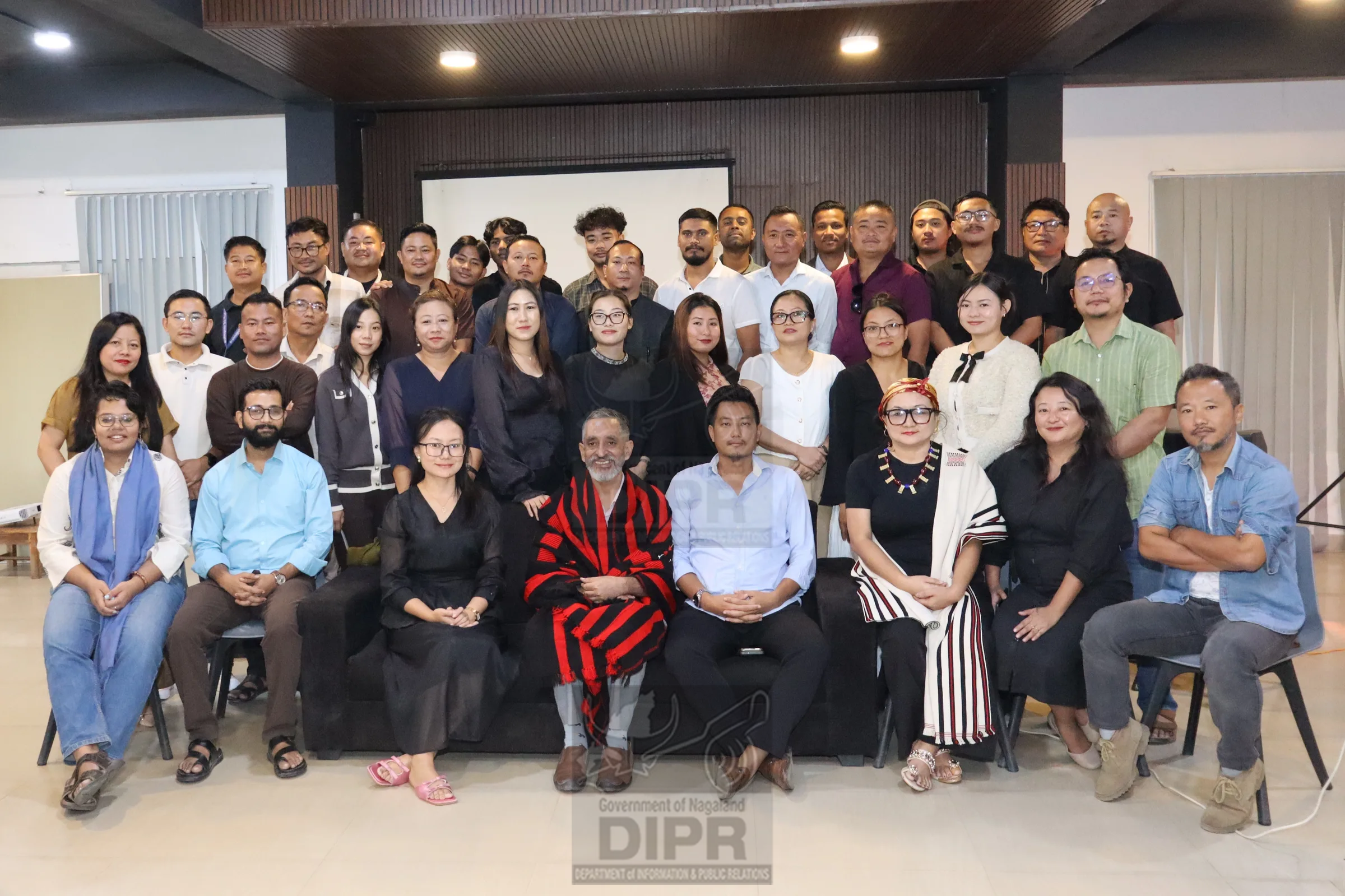
Photo News · Dimapur
Journalists have been urged to uphold the principles of a free, fair and fearless press, prioritise responsible journalism and adapt to emerging technologies while maintaining credibility and ethical standards. The appeal was made during the observance of National Press Day in Dimapur on November 16, 2026 at Dimapur, under the theme “Journalism: Populist or Responsible”.
The programme was organised by the Dimapur Press Club as part of the observance of the National Press Day. It brought together media professionals and stakeholders to deliberate on the role and responsibilities of journalism in contemporary society. values.
Journalist and Trustee of The Reporters Collective Trust, Nitin Sethi, spoke at length on the evolving role of journalism, the challenges faced by media professionals in the Northeast and the need for journalists to remain committed to holding the powerful accountable.
Describing journalists as interlocutors between different worlds and realities, he said their responsibility was to bridge the gap between the powerful and the powerless. While journalists themselves often lack resources and influence, he said society expects them to question those in authority and make them accountable to the most vulnerable sections.
He acknowledged that the nature of journalism was inherently challenging and often discouraging, as journalists may not witness immediate results despite their efforts. However, he said transforming society and correcting injustices that have developed over generations cannot be achieved within a single lifetime.
Highlighting the distinct challenges of journalism in Nagaland and other parts of the Northeast, Sethi said journalists often work in societies where relationships between communities, the State and the larger nation are still evolving. They also face pressure from community groups and influential individuals not to report on certain issues or personalities on the grounds of community identity.He observed that such challenges make the practice of journalism in the region particularly demanding, as journalists must negotiate their professional responsibilities while navigating complex social and political realities.
Sethi also reflected on the changing nature of journalism, tracing its evolution from pamphleteering and opinion-based publications to the establishment of newspaper institutions shaped by capital and commercial interest. He said technological developments, particularly social media platforms such as YouTube and Instagram, have once again democratised the media space by enabling individuals to produce and distribute content with minimal resources.
While acknowledging concerns over the changing standards of journalism, he suggested that traditional media should not dismiss emerging digital platforms and independent content creators. Instead, he called for greater engagement, dialogue and cooperation, allowing different media practitioners to exchange views even when they disagree.
He maintained that journalism should remain a space where differences of opinion are respected and meaningful conversations are encouraged.
Comparing media practices in Nagaland with other parts of the country, Sethi said journalists in the State were not necessarily performing worse than their counterparts elsewhere and, in many instances, were doing equally well or even better. He cautioned against judging local journalism solely by the shortcomings of its practitioners, pointing out that media-related corruption and compromised journalism existed on a much larger scale in other parts of the country.
Drawing from his experience of witnessing several technological transitions in journalism, he said every major development, from the printing press and computers to mobile phones and AI, had initially generated apprehension among media professionals.However, he stressed that journalists must continuously adapt rather than resist change, adding that technology itself was not intelligent but depended on how people chose to use it.
He encouraged media organisations and individual journalists to challenge themselves by learning and adopting at least one new skill or practice every few months. He also emphasised that limited infrastructure and financial resources should not become excuses for stagnation.
Sethi further stressed the importance of developing digital audiences and learning to communicate with readers beyond one's immediate geographical and social environment. He said journalists must understand that reporting for local audiences could differ significantly from writing for readers in other parts of India or abroad, where the social and political context of Nagaland may not be familiar.
Calling for greater recognition of journalists and their work, he suggested that media professionals could collectively establish an annual award to recognise outstanding journalism, even through small monthly contributions from members.He said financial rewards were not necessarily the most important aspect, but appreciation and recognition could encourage journalists who often work under difficult conditions with limited resources.Concluding his address, Sethi reminded journalists that meaningful change rarely happens overnight and that persistence was essential to making those in power accountable. He encouraged media professionals to celebrate their commitment and passion for journalism, not just on National Press Day but throughout the year, while continuing to work towards a more equitable and accountable society.
Vice President of Dimapur Press Club, Bendangchuba, while delivering the presidential address, said that National Press Day was not merely an occasion to celebrate an event but to reaffirm the idea of a free, fair and fearless press. He said press freedom should not be viewed as a privilege enjoyed by journalists but as a trust entrusted to them by the people.
Observing that journalism today stands at a crossroads, he said the profession faces increasing pressure to be fast, loud and viral, while its fundamental responsibility remains to be accurate, fair and accountable. He called upon journalists to choose credibility over clicks, unity over division and truth over trends, emphasising that responsible journalism should unite people around facts rather than create divisions.
Making three appeals, he urged the State Government to treat the press as a partner by providing timely information and ensuring the protection of journalists; appealed to the public to support local journalism, question information and refrain from encouraging fake news through social media shares; and called upon media professionals to recommit themselves to journalistic ethics by remaining fearless yet fair, and quick yet accurate.
He also expressed appreciation for the participation of almost all print and electronic media organisations in the National Press Day observance, describing it as an encouraging sign of growing unity among media fraternity in Dimapur.
The event included a welcome address by Imkong Walling, Advisor, DPC, followed by an interactive question-and-answer session. While, Vote of thanks was delivered by Talimongla Longkumer, Finance Secretary, DPC.