
Photo News · Kohima
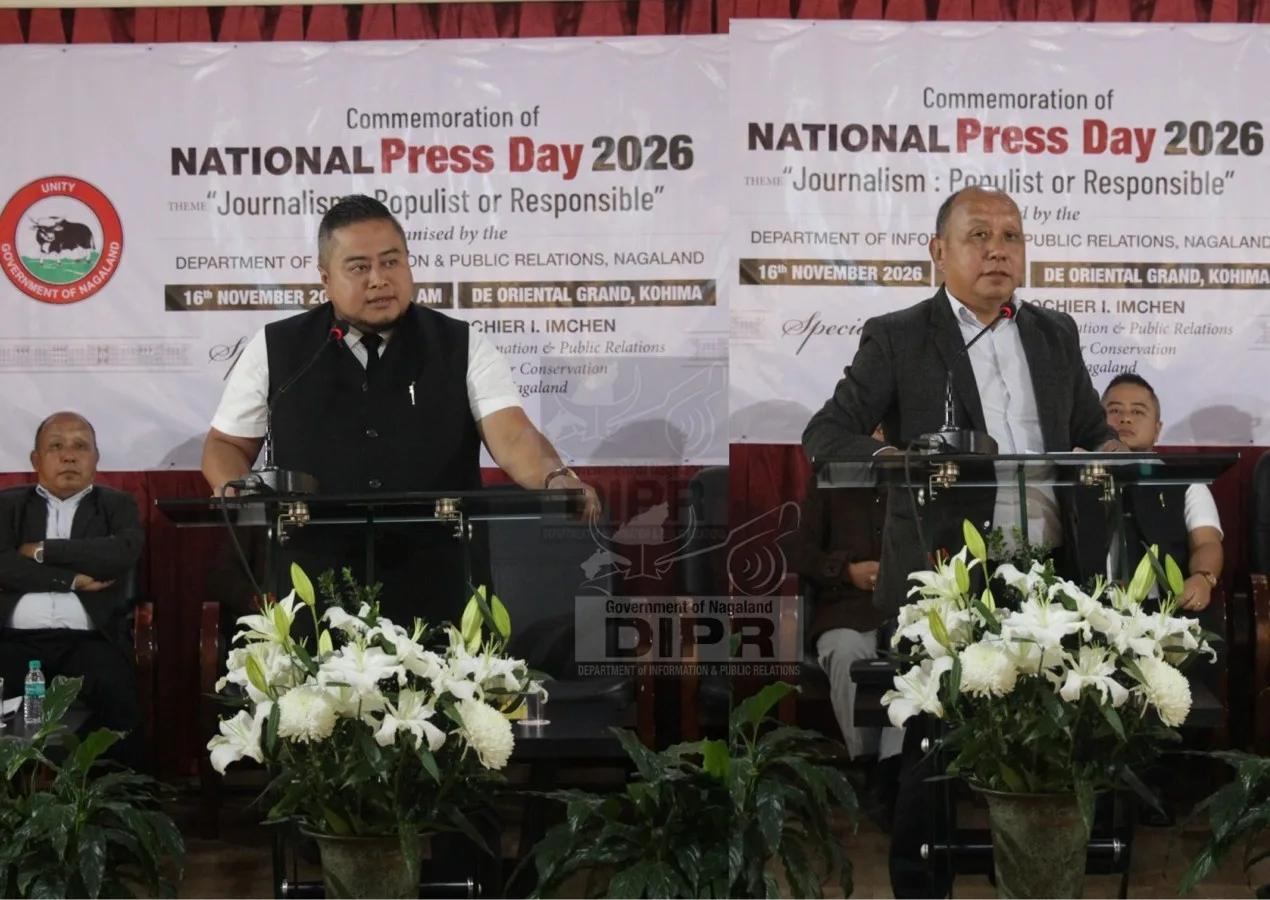
The Department of Information and Public Relations (DIPR) organised the State-level commemoration of the National Press Day 2026, under the theme “Journalism: Populist or Responsible” at De Oriental Grand, Kohima, on 16th November 2026. Advisor, Information & Public Relations and Soil & Water Conservation, Daochier I. Imchen, attended the programme as the special guest.
Addressing the gathering, Advisor Daochier I. Imchen called upon journalists to uphold truth, integrity, accountability and responsible journalism, describing the press as one of the strongest pillars of democracy. He said National Press Day was not merely an occasion to celebrate journalism but also to recognise the courage and responsibility of media professionals in speaking the truth, questioning authority and holding those in power accountable.
Observing that information often travels faster than truth in the present digital age, he cautioned against sensationalism and the growing tendency to prioritise popularity over credibility. He urged journalists to uphold accuracy, fairness and public interest rather than being driven by the race to break news.
Highlighting the role of the media in Nagaland, Imchen said that the press must serve as a bridge between the government and the public, giving voice to the concerns and aspirations of farmers, unemployed youth, entrepreneurs and neglected villagers. He stressed the need for constructive journalism that not only highlights challenges but also explores solutions, promotes understanding and inspires positive change.
Emphasising that press freedom must go hand in hand with responsibility, he stated that while freedom gives journalism its voice, responsibility earns it credibility and public trust. He added that the true measure of journalism lies not in the number of headlines or controversies it generates, but in the trust it commands, and the positive difference it makes in society.
He also highlighted various initiatives undertaken by DIPR for the welfare of the media fraternity, including the Journalist Welfare Fund, operational subsidy for accredited journalists and official accreditation to facilitate access to government information and official functions. He recalled that tablets were distributed to 40 working journalists on the occasion of the 63rd Statehood Day on 1st December 2025, and that all accredited journalists are covered under the Chief Minister’s Health Insurance Scheme (CMHIS).
Calling upon media professionals to remain fearless yet fair, critical yet constructive, and independent yet responsible, Imchen urged journalists to choose facts over sensationalism and responsibility over popularity. He concluded by stating that the duty of the press was neither to please the powerful nor to provoke the public, but to pursue the truth with courage and integrity.
Speaking on behalf of the media fraternity of Nagaland, senior journalist H. Chishi highlighted the growing challenges facing journalism, citing increasing corporate and political influence, populism and the rapid expansion of social media as factors affecting the credibility and independence of the media. He observed that some mainstream media organisations were increasingly shifting towards serving political and corporate interests rather than questioning those in power.
Chishi stressed that media organisations must move beyond routine reporting and the race to break news, placing greater emphasis on verification, contextual reporting, analysis and meaningful storytelling. He said that the traditional practice of merely reporting statements and counter-statements was no longer sufficient to sustain mainstream media in the changing information landscape.
He also pointed out that the emergence of citizen journalism, independent digital platforms, YouTubers and podcasters had transformed the media environment, making it increasingly difficult for audiences to distinguish credible reporting from opinion and misinformation. He called upon journalists to adapt through stronger digital literacy, critical thinking and adherence to professional ethics.
Underscoring the continuing importance of print media, Chishi said newspapers continue to provide comprehensive and reliable information and maintain a sense of trust and credibility despite growing digital competition. However, he cautioned that declining circulation, reduced advertising revenue and the closure of newspapers posed serious challenges to the print media industry.
Referring to Nagaland's media landscape, he said that the press had played a significant role in shaping the State despite numerous challenges. He emphasised that journalists carried a greater responsibility in Nagaland's unique and sensitive social environment, particularly during situations of conflict and division. He urged the media to avoid reporting that could aggravate tensions, and instead promote peace, understanding and public welfare.
He further stressed that accountable journalism must go beyond relying on press releases and official handouts, ensuring truthful, impartial and fair reporting while critically examining issues and holding those in power accountable.
Calling upon journalists to remain relevant in an increasingly competitive media environment, Chishi highlighted the importance of adaptability, resilience and an unwavering commitment to truth-telling. He stated that the strength of journalism lies in its ability to inform and motivate the public while ensuring accountability.
He concluded by emphasising that an independent and responsible media remains essential to democracy, safeguarding people's rights and freedoms, encouraging informed public debate and strengthening democratic values.
The programme was chaired by Joint Director, DIPR, I. Simon Teilia, while Deputy Director, DIPR, S. Hongpi Konyak, delivered the vote of thanks.
(Morotsung Longchar, IA)